
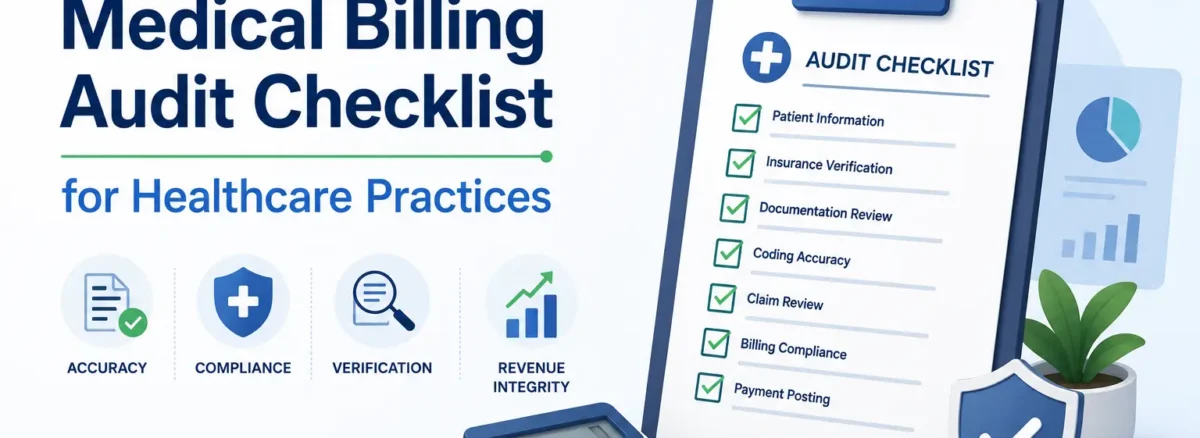
A medical billing audit is a practical review of your entire billing process to uncover errors, find missed revenue opportunities, and confirm compliance with payer expectations.
It examines every stage—from patient registration at the front desk, through charge capture and coding, to claim submission, payments, and accounts receivable. Providers use audits to fix leaks that quietly drain income, like unbilled services or coding slip-ups.
Think of it as a health check for your revenue cycle: proactive audits prevent small problems from becoming big losses. In this article, we’ll walk you through a simple medical billing audit checklist, what to review at each stage, and how to fix issues that impact your revenue.
Why Billing Audits Matter for Your Revenue
Billing audits are your best defense against silent revenue killers like errors and oversights that slip through a busy practice. A single missed charge or denial can snowball, but audits pinpoint them fast, turning losses into recovered income. They reveal hidden issues across your workflow, boosting overall collections.
Common problems audits uncover:
| Problem | Revenue Impact |
| Missed charges | Direct loss of income |
| Coding errors | Frequent denials |
| Delayed claims | Cash flow disruptions |
| Underpayments | Partial reimbursements |
When Should You Perform a Billing Audit?
Timing your billing audits right keeps issues small and revenue flowing steadily—don’t treat them as an afterthought. Schedule them routinely to catch trends early, or trigger them when red flags appear.
Don’t wait for problems—regular audits prevent revenue loss.
Recommended cadence:
- Monthly: Quick internal spot-checks on 10–20 recent claims for basics like charge capture and denials.
- Quarterly: Deeper dive into 50–100 claims, reviewing coding accuracy and AR aging.
- Annually: Comprehensive audit of the full year, often with external help for objectivity.
Key triggers to audit immediately:
- Sudden increase in denials (over 10%).
- Unexplained drop in monthly revenue.
- Payments are delayed beyond 30–45 days.
- Staff changes in the billing or front desk.
Starting with monthly habits builds momentum. Track metrics like clean claim rate pre- and post-audit to measure impact.
Front-End Audit Checklist (Before the Claim Is Created)
Most billing headaches originate at the front end, where patient data enters the system—so auditing here catches 40–50% of issues early. Focus on registration and verification to ensure claims start clean. Most billing issues start at the front desk level.
Use this simple checklist for 10–20 recent encounters:
- Patient demographics are accurate: Verify name, DOB, address, and contact info match ID—no typos that trigger rejections.
- Insurance details are verified: Confirm policy number, group ID, and primary/secondary payers are current.
- Eligibility is confirmed: Check coverage active on service date via payer portal or phone (key for Medicare/Medicaid).
- Authorization is obtained (if required): Document pre-approvals for procedures, tests, or high-cost services.
Insight: Front-desk slips like unverified eligibility cause instant denials. Train staff with templates and spot-audit weekly to build accuracy—your downstream revenue will thank you.
Coding & Charge Capture Audit Checklist
Coding and charge capture are revenue powerhouses—errors here directly slash reimbursements, so auditing them uncovers the biggest wins. Review documentation against bills to spot gaps. Missed or incorrect charges directly lead to lost revenue.
Checklist for high-impact review (sample 20–50 claims):
- Services are fully documented: Charts detail procedures, time spent, supplies, and outcomes supporting billing.
- Correct CPT/HCPCS codes are used: Matches documentation—no generic codes hiding higher reimbursable ones.
- Modifiers are applied correctly: Like -25 for separate E/M services, or -59 for distinct procedures.
- No undercoding or overcoding: Avoid low-balling levels or inflating—balance compliance and accuracy.
- All billable services are captured: Include injections, tests, counseling, and supplies—not just the main visit.
Claims Submission Audit Checklist
Claims submission is your last gate before payers—auditing here ensures they leave clean and payable. Botched submissions lead to denials you could avoid. Clean claims mean faster payments and fewer denials.
Review recent batches with this checklist:
- Claims are submitted on time: Within payer timely filing limits (e.g., 90–180 days).
- No missing or incorrect fields: All required data, like patient ID, diagnosis pointers, and rendering provider, were filled accurately.
- Payer rules are followed: Match specific formats, like local coverage determinations (LCDs) or prior auth notes.
- Clean claims rate is monitored: Aim for 95%+ acceptance; track rejections via clearinghouse reports.
AR & Denial Management Audit Checklist
Accounts receivable (AR) and denials hide massive revenue leakage—auditing them recovers cash sitting idle. Focus on aging buckets to prioritize. Unresolved AR is one of the biggest sources of revenue leakage.
Key checklist items for AR over $10K or high denial volume:
- AR aging is monitored: Break down 0–30, 30–60, 60–90+ days; flag anything over 90 for urgent action.
- Denied claims are tracked and resolved: Categorize by reason (e.g., coding, eligibility) and appeal within deadlines.
- Follow-ups are done regularly: Automated worklists for calls/emails to payers; log every touch.
- Underpayments are identified: Compare payments to allowed amounts; reclaim differences promptly.
Pro tip: Run weekly AR reports and target top denial codes. Practices recover 30–50% of stalled AR this way, turning audits into immediate revenue boosts.
How MedAce Can Help Improve Your Billing Audit Process
Audits uncover issues, but fixing them across a full revenue cycle takes expertise—MedAce provides that support to turn insights into results. We go beyond checklists, delivering actionable optimizations for your practice.
How we assist:
- Identify gaps across the revenue cycle: Full audits from front-end to AR, spotting hidden losses.
- Reduce denials and missed charges: Targeted fixes like coding reviews cut errors by 25–40%.
- Improve billing accuracy and efficiency: Training, tools, and processes for sustained clean claims.
- Support ongoing audit and optimization: Monthly monitoring prevents problems from recurring.
With the right billing support, audits become a tool for growth—not just a compliance task.