

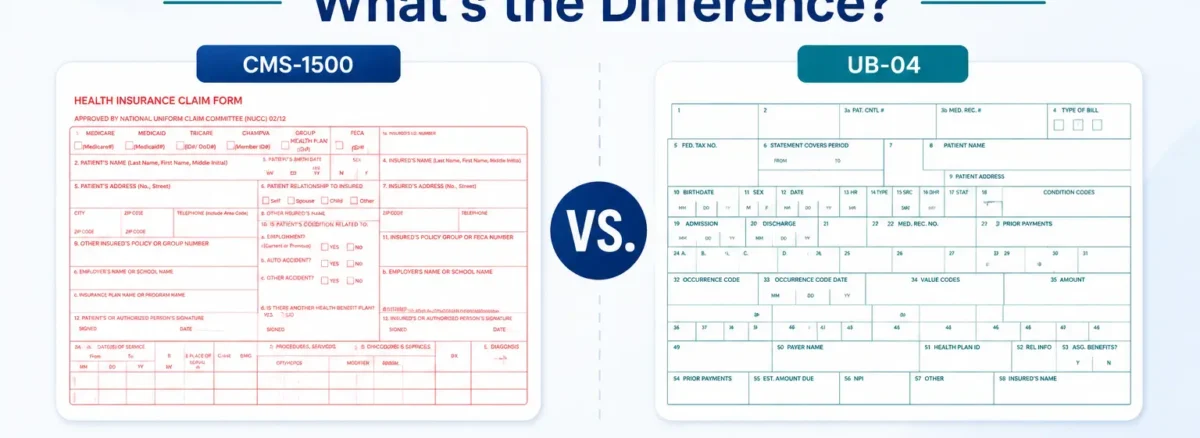
CMS-1500 and UB-04 are two of the most commonly used healthcare claim forms in the United States. Both are used to request reimbursement from insurance companies, but they serve different purposes and are submitted by different types of providers.
Knowing the difference matters because using the wrong claim form can lead to claim rejections, payment delays, and unnecessary follow-up work for billing staff. A simple form mismatch can slow down reimbursement even when the service itself was covered and properly documented.
In this article, we’ll explain the differences between CMS-1500 and UB-04 claim forms, when each one should be used, how they relate to electronic claims, and the common billing mistakes providers should avoid.
What Is the CMS-1500 Claim Form?
The CMS-1500 is the standard claim form used by non-institutional providers to bill for professional medical services. It is commonly used by physicians, nurse practitioners, physician assistants, physical therapists, chiropractors, psychologists, and other individual healthcare professionals.
This form is designed to capture the information needed to bill for the clinician’s work, not the facility where care was delivered. It typically includes patient demographics, insurance details, provider information, diagnosis codes, and procedure codes that describe the professional services performed.
In simple terms, the CMS-1500 is used when the provider is billing for medical expertise, evaluation, treatment, or other professional services. It helps insurance companies understand who provided the care, what was done, and why the service should be reimbursed.
Because it is tied to professional services, the CMS-1500 is the form most often associated with office visits, consultations, therapy sessions, and other outpatient services billed by individual practitioners or group practices.
What Is the UB-04 Claim Form?
The UB-04, also called the CMS-1450, is the standard claim form used by institutional healthcare facilities to bill for facility-based services. It is commonly used by hospitals, skilled nursing facilities, rehabilitation centers, hospice organizations, dialysis centers, and other institutional providers.
This form is designed to capture charges tied to the facility rather than the individual clinician. It may include room and board, emergency department services, operating room charges, laboratory services, and other hospital or facility costs that are part of the patient’s stay or treatment.
In simple terms, the UB-04 is used when the facility itself is billing for the setting and services provided within that setting. It helps insurers separate facility charges from professional services that may be billed separately by a physician or other individual provider.
CMS-1500 vs. UB-04: Side-by-Side Comparison
Here’s a quick comparison of the two forms and how they differ in everyday billing.
| Feature | CMS-1500 | UB-04 (CMS-1450) |
| Primary Purpose | Bills professional medical services | Bills institutional or facility services |
| Common Users | Physicians, specialists, therapists, independent providers | Hospitals, SNFs, rehabilitation centers, hospice, dialysis facilities |
| Electronic Equivalent | 837P | 837I |
| Code Sets | CPT, HCPCS, ICD-10-CM | CPT/HCPCS (when applicable), ICD-10-CM, revenue codes, occurrence codes |
| Typical Charges | Office visits, consultations, procedures, professional services | Facility fees, room charges, emergency services, inpatient and outpatient facility costs |
| Maintained By | National Uniform Claim Committee (NUCC) | National Uniform Billing Committee (NUBC) |
Although both forms may relate to the same patient encounter, they represent different parts of the healthcare service. The CMS-1500 covers the professional work of the clinician, while the UB-04 covers the facility’s charges for providing the setting and support for care.
Which Claim Form Should You Use?
The right form depends on whether the service was billed as a professional service or a facility service. In many cases, the same patient encounter can generate two separate claims: one for the clinician’s work and another for the facility’s charges.
| Scenario | CMS-1500 or UB-04? | Explanation |
| Office visit with a family physician | CMS-1500 | Professional services provided by an individual physician. |
| Inpatient hospital stay | UB-04 | Facility charges billed by the hospital. |
| Surgeon performing surgery at a hospital | CMS-1500 | The surgeon bills professional services separately from the hospital. |
| Hospital operating room charges | UB-04 | Facility-related charges belong to the hospital. |
| Physical therapy at an independent outpatient clinic | CMS-1500 | Professional therapy services are billed by the clinic or therapist. |
| Skilled nursing facility services | UB-04 | Institutional services are billed by the facility. |
It is common for a patient to receive both a CMS-1500 claim and a UB-04 claim for the same episode of care. That happens because professional medical billing services and facility services are billed separately, even when they are part of the same treatment event.
Common Billing Mistakes and How to Avoid Them
Using the wrong claim form is one of the most common billing errors, and it can quickly lead to claim rejection or delayed payment. The same is true when professional charges and facility charges are confused, because payers need each type of service reported on the correct form.
Other frequent mistakes include missing or incorrect provider information, incorrect CPT, HCPCS, or revenue codes, and submitting the wrong electronic claim format. Incomplete documentation is another major issue, since the billed service must be clearly supported in the medical record.
Here are the mistakes to watch for:
- Using the wrong claim form.
- Confusing professional and facility charges.
- Missing or incorrect provider information.
- Incorrect CPT, HCPCS, or revenue codes.
- Submitting the wrong electronic claim format, such as using the wrong digital version for the claim type.
- Incomplete documentation supporting the billed services.
These errors often trigger claim rejections, payment delays, or requests for corrected claims. Careful claim review before submission helps reduce preventable denials and keeps reimbursement moving more smoothly.
CMS-1500, UB-04, and Electronic Claims
Most providers now submit claims electronically, even though paper forms still exist in some workflows. The digital version of the CMS-1500 is the 837P, while the digital version of the UB-04 is the 837I.
These electronic transactions carry much of the same information as the paper forms, but they are transmitted digitally through clearinghouses or sent directly to payers. That makes them faster to process and easier to track than paper claims.
Understanding this relationship helps providers troubleshoot submission problems more effectively. If a claim is rejected electronically, knowing whether it should have been sent as an 837P or 837I can save time and reduce avoidable billing errors.
In practice, the claim type still matters even when the submission method changes. Choosing the correct format supports cleaner claim transmission, better payer acceptance, and faster reimbursement.
How MedAce Can Help
Accurate claim submission starts with choosing the correct claim form and following each payer’s billing rules. When those details are handled well from the beginning, providers are in a better position to reduce denials and get paid faster.
MedAce supports providers with services that help strengthen the billing process from start to finish:
- Medical billing.
- Medical coding.
- Claim scrubbing.
- Electronic claim submission.
- Denial management.
- Accounts receivable follow-up.
- Revenue cycle reporting.
- Billing compliance support.
Whether you’re billing professional services, institutional services, or managing a complex revenue cycle, MedAce helps healthcare providers improve claim accuracy, reduce denials, and streamline the reimbursement process through expert medical billing and revenue cycle management services.
FAQ
1. What is the main difference between a CMS-1500 and a UB-04 claim form?
The CMS-1500 is used by individual healthcare providers (like doctors, therapists, and specialists) to bill for their professional expertise and services. The UB-04 (or CMS-1450) is used by institutional facilities (like hospitals, nursing homes, and rehab centers) to bill for facility usage, equipment, room charges, and nursing care.
2. Can a patient visit result in both a CMS-1500 and a UB-04 claim?
Yes, it is very common for a single medical event to generate both forms. For example, if a surgeon performs an operation at a hospital, the surgeon submits a CMS-1500 for their professional work, while the hospital submits a UB-04 to bill for the operating room, equipment, and inpatient stay.
3. What are the electronic equivalents of the CMS-1500 and UB-04 forms?
When submitted digitally, the CMS-1500 professional claim becomes an 837P electronic file, and the UB-04 facility claim becomes an 837I electronic file. Even though they are sent electronically through billing software or clearinghouses, they follow the exact same rules and guidelines as the paper forms.
4. What happens if a practice submits a claim on the wrong form?
Submitting professional services on a UB-04 or facility charges on a CMS-1500 will result in immediate claim rejections or denials from insurance payers. This causes unnecessary administrative rework, payment delays, and potential cash flow disruptions until a corrected claim in the right format is resubmitted.
5. What medical coding systems are used on each form?
Both forms use ICD-10-CM codes for patient diagnoses and CPT or HCPCS codes for procedures. However, the UB-04 form uniquely requires revenue codes and occurrence codes to categorize specific facility-related fees, departments, and timelines associated with hospital stays or specialized care.
6. What are the most common billing mistakes to avoid with these forms?
The most frequent errors include mixing up professional and facility charges, selecting the wrong electronic claim format (837P vs. 837I), leaving out provider details, using incorrect CPT or revenue codes, and submitting claims with incomplete clinical documentation to support the billed service.