
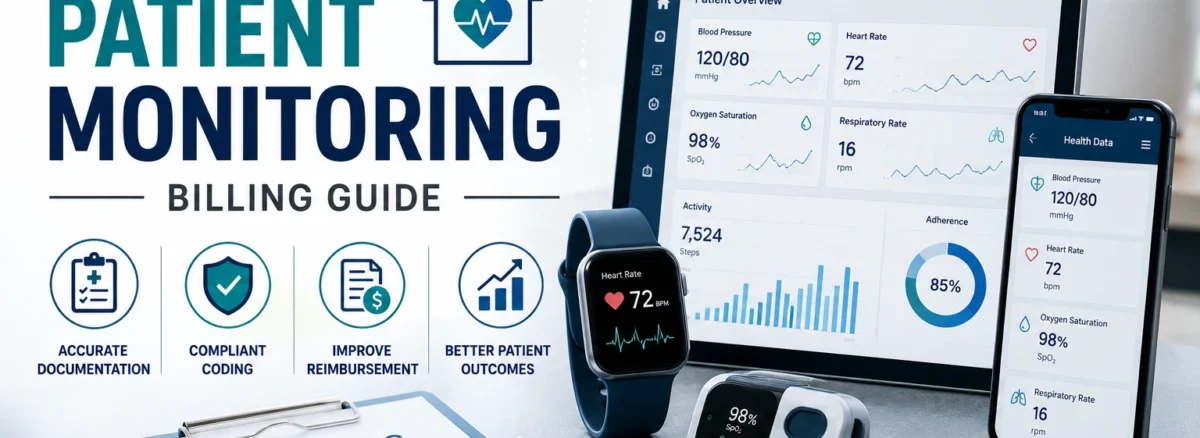
Remote Patient Monitoring (RPM) lets providers bill Medicare and many commercial payors for tracking patients remotely with connected devices—like blood pressure cuffs, glucose meters, or pulse oximeters. It’s a non-face-to-face service, meaning you get paid for reviewing data, adjusting care, and communicating between visits.
RPM follows a monthly billing model: Supply FDA-approved (or equivalent) devices, collect readings, spend time managing, and submit claims. Reimbursements range from $50 to $150+ per patient monthly, stacking device setup fees with care time.
RPM lets you get paid for monitoring patients between visits—many practices work informally anyway. Ideal for chronics like diabetes or HTN, it boosts outcomes while adding predictable income. No extra office time needed; just smart tech and documentation.
In this article, we’ll explain RPM billing, CPT codes, rules, and how to implement it in your practice for consistent monthly revenue.
Why RPM Matters for Your Practice (Revenue + Care Benefits)
Remote Patient Monitoring turns routine monitoring into a predictable revenue stream while improving care quality and patient engagement.
By billing monthly for device supply and time spent managing data, practices gain a steady income that scales with enrollment.
Clinically, continuous monitoring catches issues early, boosts adherence, and reduces hospital visits—benefits that improve outcomes and lower overall costs.
Key benefits
- Monthly Medical Billing: Generates recurring, predictable revenue from enrolled patients.
- Continuous monitoring: Detects trends and early deterioration before emergencies occur.
- Patient engagement: Regular data review and outreach improve adherence and retention.
- Reduced admissions: Early intervention can lower ER visits and readmissions.
- Scalable model: Programs grow without proportionally increasing in‑office workload.
Benefit — Impact
Monthly billing — Predictable, recurring income
Continuous monitoring — Early issue detection
Patient engagement — Stronger adherence and retention
Hospital reductions — Fewer readmissions and cost savings
Example
A 50‑patient RPM panel billing an average of $80 per patient per month produces about $4,000/month (approximately $48K/year). As enrollment grows, revenue scales while clinical staff focus on higher‑value interventions rather than routine data collection.
RPM blends improved patient care with a steady new revenue line—making it an efficient, high-impact program for primary care and chronic‑disease management.
Who Qualifies for RPM Services?
RPM targets patients needing ongoing oversight—not every patient qualifies, so selection matters for billing success.
Eligibility basics:
- Chronic conditions: Diabetes, HTN, heart failure.
- Acute needs: Post-surgery, rehab monitoring.
- Device use: FDA-approved or standard (e.g., connected BP/glucose).
Key rule: Collect data 16+ days in a 30-day period—automatic transmission required.
Primary care panels often have 30–50% fits; screen via EHR for HTN + device access. Consent once; no minimum visits.
RPM CPT Codes Explained (Simple Breakdown)
Master these four codes—RPM bills device + time components monthly. RPM billing combines device + time-based codes for full pay.
| Code | What It Covers | 2026 Reimb. Est. |
| 99453 | Device setup & patient education (once/36 mos) | ~$19 |
| 99454 | Monthly device supply/data transmit (16+ days) | ~$56 |
| 99457 | 20 mins physician/QHP management | ~$50 |
| 99458 | Each add’l 20 mins | ~$41 |
Bill 99454 + 99457 minimum per month. Track interactive time (calls, reviews). Stackable with CCM; no double-dipping devices.
Step-by-Step RPM Billing Workflow (How It Works in Practice)
RPM runs monthly—repeatable and scalable. RPM is a monthly recurring billing cycle, not a one-time service.
- Identify patients: Screen chronics; get consent.
- Provide device: Ship connected BP/glucose, monitor.
- Onboard: Educate via video/call (bill 99453 once).
- Collect data: Auto 16+ days/30; review trends.
- Manage care: Log 20+ mins (calls, plans, alerts).
- Document: Timestamp everything in EHR.
- Bill monthly: Submit by period end.
Use platforms for auto-data; delegate reviews.
RPM Billing Rules & Requirements (Avoid Denials)
Stick to these or face audits—missing even one requirement can lead to claim denial.
Must-haves:
- 16+ days of data in a 30-day period (auto-transmit).
- Accurate time logs: 20-min increments, interactive (not passive review).
- Communication: Calls, portal messages tied to data.
- Full docs: Consent, plans, device details.
- One org per patient: No duplicate billing.
Medicare leads; commercials follow. Audit quarterly—common denial: under-16 days. Templates save headaches.
Example: How RPM Generates Monthly Revenue
Primary care practice enrolls 50 RPM patients on BP/glucose devices.
Breakdown:
- 99454 (device): $56/patient.
- 99457 (20 mins): $50/patient.
- Total: $80–$120/patient/month (add 99458 for complex).
- 50 patients: $4,000–$6,000+ monthly.
- Annual: $48K–$72K recurring.
RPM scales easily—more patients = more recurring revenue. Add 99453 setups: $1K one-time boost. One clinic hit $10K/month at 100 patients.
How MedAce Can Help You Implement and Optimize RPM Billing
MedAce makes launching and scaling RPM simple and compliant. We build custom workflows that handle device selection and procurement, patient onboarding and consent, automatic data capture, and monthly claim preparation so your team doesn’t need to reinvent processes.
Our coding specialists ensure correct CPT use (99453–99458), stack codes properly, and document interactive time to meet payer requirements. We automate time and data logs to meet the 16‑day transmission rule and keep audit‑ready records. On the revenue side, MedAce posts payments, reconciles remittances, and aggressively appeals denials to protect collections.
We also provide ongoing program optimization—enrollment strategies, staff training, performance dashboards, and KPI reviews—to increase patient uptake and revenue per patient. Practices typically see faster time‑to‑revenue and fewer denials with our end‑to‑end support.