
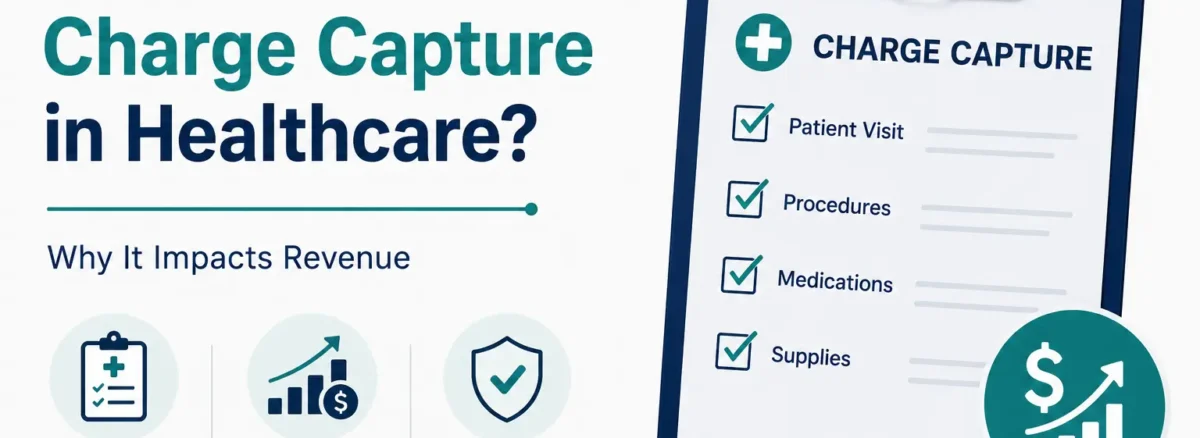
Charge capture is the straightforward process of recording every billable service you provide to a patient during their visit. Think of it as capturing the full picture of what happened—from procedures and tests to drugs and supplies—so nothing gets missed.
It’s the essential first step in the billing process that ensures your practice gets paid fairly and promptly for the care you deliver.
Many providers handle this right after seeing a patient, entering details into their system before moving on.
In this article, we’ll explain how charge capture works, why it directly impacts your revenue, and how to avoid common mistakes that lead to lost income.
Why Charge Capture Matters for Your Revenue
Charge capture is a make-or-break step for your practice’s revenue because every service you provide must be recorded accurately to get paid. If something slips through—like a quick test or supply used during a visit—it simply isn’t billed, turning potential income into permanent loss.
Even small errors, such as wrong details, can trigger claim denials or underpayments, leading to time-consuming fixes and delayed cash flow.
Let’s say you spend time delivering great care, but without proper capture, your billing team has nothing to work with downstream. This creates ripple effects, from slower payments that strain your operations to missed opportunities for growth.
Here’s a quick breakdown of common issues and their real-world impact:
| Issue | Impact |
| Missed charge | Permanent revenue loss—no bill, no pay |
| Delayed entry | Cash flow delays and backlog buildup |
| Incorrect entry | Denials, underpayments, or rework |
Providers who nail charge capture see steadier revenue, fewer headaches, and more funds to reinvest in their practice. It’s not just about billing; it’s about protecting the value of your daily work.
Where Charge Capture Fits in the Billing Process
Charge capture sits right in the middle of your medical billing workflow, bridging the gap between hands-on patient care and getting paid. It ensures that what happens in the exam room flows smoothly into revenue. If this step falters, everything downstream—from coding to payments—grinds to a halt.
Here’s the simple workflow in action:
- Patient visit: You see the patient, perform exams, procedures, or give treatments.
- Documentation: Note details in the patient’s chart, including services, supplies, and notes.
- Charge capture: Enter billable items into your system (this is the key step we’ll focus on).
- Coding: Assign CPT or HCPCS codes to those charges.
- Claim submission: Send the claim to the payer.
- Payment: Receive reimbursement (or handle any issues).
Charge capture connects your clinical work directly to billing success. Skip or mess it up, and claims weaken or fail entirely, costing you time and money. Mastering this keeps your revenue cycle running like clockwork.
How Charge Capture Works in Real Practice (Step-by-Step)
In everyday practice, charge capture turns busy patient visits into billable records through a clear, repeatable process. It’s practical and flexible, fitting into how you already work—whether in a clinic, hospital, or solo office.
Let’s walk through it with a real-world example: a patient comes in for a routine consultation that includes an injection for pain relief.
Here’s the step-by-step breakdown:
- Provider performs the service: You greet the patient, discuss their symptoms, conduct the exam, administer the injection, and note any supplies like the medication vial or needles used.
- Document the visit thoroughly: Jot down key details in the patient’s chart—office visit level, injection procedure, exact drug given, dosage, and any extras like bandages.
- Enter charges into the system: Right away (or soon after), input these billable items into your EHR, billing software, or charge capture tool. This captures the “what” before codes are added.
- Codes get assigned: Your team or software matches entries to standard codes like CPT for the visit and injection, plus HCPCS for the drug.
- Charges hand off to billing: Everything flows to the billing team for claim creation and submission.
You can handle this manually via paper lists (though slower), through integrated EHR systems that auto-prompt charges, or with mobile apps for on-the-go entry during rounds.
The key? Doing it promptly keeps things accurate and your revenue moving. This method works for any visit size, from quick check-ins to complex procedures.
Real Example: How Missed Charge Capture Leads to Revenue Loss
Nothing drives home the importance of charge capture like a real-world example of what happens when it’s overlooked. Imagine a busy day in your practice: A patient arrives complaining of joint pain.
You provide a level 3 office visit (99213), administer a common corticosteroid injection (like triamcinolone, CPT 20610 or similar), and use a medication vial plus sterile supplies.
What correct capture looks like:
- Office visit billed: Around $75–$100 reimbursement.
- Injection procedure billed: $50–$100.
- Medication/supplies billed: $20–$50 for the drug.
- Total: Full payment of $145–$250, depending on payer and location.
What happens with a missed charge:
- You document and bill the visit and injection perfectly.
- But the drug vial? Forgotten in the rush—no entry in the system.
- Result: Payer reimburses only the visit and procedure. The $20–$50 drug charge vanishes forever.
- Multiply by 10 patients a week: That’s $200–$500 lost weekly, or thousands yearly.
Even small oversights like this—supplies, follow-up tests, or extra counseling—add up fast across a practice. One study from healthcare revenue experts notes practices lose 5–10% of potential revenue to these gaps. Spotting and fixing them protects your income without extra effort.
Common Charge Capture Mistakes Providers Should Avoid
Providers face predictable pitfalls in charge capture that quietly drain revenue, but spotting them early makes a big difference.
These errors often stem from rushed days or disconnected workflows, yet they’re easy to prevent with simple habits. Here’s a rundown of the most common ones, with quick explanations and fixes.
- Missing services or procedures: You perform an extra EKG or wound dressing, but forget to record it.
Tip: Use checklists during visits to jog your memory.
- Not capturing supplies or drugs: Items like injections, splints, or lab kits go unbilled because they’re seen as “minor.”
Tip: Treat every used item as billable—log it immediately.
- Delayed charge entry: Charges sit in notes for days, leading to forgotten details or compliance issues.
Tip: Capture same-day, ideally before the next patient.
- Poor documentation: Vague notes like “treated pain” don’t support billing.
Tip: Be specific—include time, method, and items for coders.
- Communication gaps between the provider and the billing team: Verbal handoffs get lost.
Tip: Use shared digital systems for real-time updates.
Review charges weekly to catch patterns, and train your team on these pitfalls. Practices that do this report 20–30% fewer leaks, turning potential losses into steady gains. Staying vigilant keeps your revenue protected.
How to Improve Charge Capture in Your Practice
Boosting charge capture doesn’t require overhauling your entire setup—just smart, actionable changes that fit your workflow. These steps help providers like you capture every billable moment, reduce errors, and speed up payments. Start small, and you’ll see revenue gains quickly.
Key strategies to implement:
- Use structured documentation templates: Pre-built forms in your EHR prompt for billables like procedures, drugs, and supplies. This ensures completeness without extra thinking.
- Implement real-time charge entry: Enter charges during or right after the visit via mobile apps or EHR pop-ups. No more end-of-day scrambles.
- Train staff on billing workflows: Regular sessions teach your team to spot and log billables accurately, closing communication gaps.
- Leverage EHR tools effectively: Activate auto-charge features or AI prompts that suggest codes based on notes.
- Conduct regular audits: Monthly reviews of a sample of visits uncover missed items, often recovering thousands in back-billed revenue.
For a quick overview of benefits:
| Improvement | Benefit |
| Real-time entry | Faster billing and cash flow |
| Staff training | Fewer errors and denials |
| Audits | Recovers missed revenue quickly |
| EHR templates | Consistent, complete capture |
Practices adopting these see up to 15% revenue uplift. Pick one or two to start, track results, and build from there—your bottom line will thank you.
How MedAce Can Help Optimize Your Charge Capture Process
Struggling with charge capture gaps? MedAce steps in as your reliable partner to make it seamless and revenue-focused. We specialize in tools and support that catch what others miss, without disrupting your day-to-day care.
Here’s how we help:
- Ensure all billable services are captured accurately: Our system scans documentation in real-time, flagging procedures, drugs, and supplies for immediate entry.
- Reduce missed charges and revenue leakage: Automated audits identify and recover lost items, often adding 5–10% to your collections.
- Improve billing workflow efficiency: Integrate with your EHR for one-click charge entry, speeding up the handoff to coding and claims.
- Support end-to-end revenue cycle management: From capture to payment posting, we handle the details so you focus on patients.
With the right billing support, you can turn charge capture into a consistent and reliable source of revenue growth.
FAQ
1. What exactly is “Charge Capture” in plain English?
Think of charge capture as a digital retail receipt. Just like a grocery store scans every item in your cart, charge capture is the process of “scanning” everything you did for a patient—from the exam and the flu shot to the bandage and the medicine used. If it doesn’t get “scanned” into your system, the insurance company doesn’t know to pay you for it.
2. Why does it have such a big impact on my revenue?
In medical billing, if a service isn’t recorded, it’s essentially free labor. Even small things like a $20 vial of medicine or a $50 diagnostic test add up. If you miss just a few of these every week, your practice could be losing thousands of dollars every year in “leaked” revenue that you can never get back once the billing window closes.
3. Does charge capture happen before or after coding?
It happens before coding. Charge capture is step one: recording what happened (e.g., “I gave a knee injection”). Coding is step two: translating that action into a specific billable language (e.g., “CPT 20610”). If the charge capture step is missed, the coder has nothing to translate, and the bill never gets created.
4. What is the most common mistake providers make?
The biggest mistake is waiting until the end of the day to enter charges. When you’ve seen 20 patients, it’s easy to forget the “little things”—like the specific supply you used or an extra test you ordered on the fly. This leads to “rushed documentation,” where you only bill for the main visit and leave money on the table by forgetting the extras.
5. Can my EHR (Electronic Health Record) do this for me?
Most modern EHRs have tools to help, but they aren’t perfect. They often use templates that prompt you to check off boxes for supplies and procedures. However, if a provider doesn’t check the box or if the system isn’t set up to “talk” to the billing software correctly, charges can still fall through the cracks. It still requires a human eye to ensure the “picture” is complete.
6. How can I tell if my practice is missing charges?
The best way to tell is through a mini-audit. Compare your clinical notes for five random patients against the actual bill that was sent out. If your notes say you gave a patient a splint, but the bill only shows an office visit, you have a charge capture gap. Many practices find that they are accidentally giving away 5% to 10% of their income this way.